Showing posts with label Architecture. Show all posts

Sunday, 14 September 2008

The Life-Giving Cross

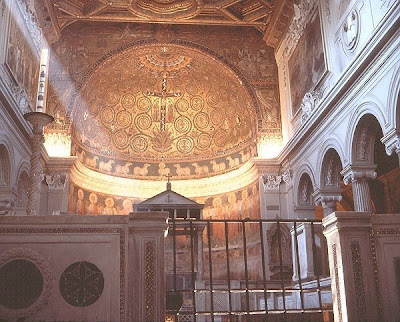
No visit to Rome, the Eternal City, would be complete without a visit to the Basilica of Saint Clement. A short walk away from both Saint John Lateran and the Colosseum, this ancient church is an architectural Victoria Sponge Cake, consisting of three levels; A medieval basilica on top, a far earlier church in the middle, and the dark dank remains of an ancient Roman street (complete with Mithraeum) beneath the two. The Mithraeum on the lowest level, and the wall-paintings on the middle layer are impressive in their own right, but upon entering the Church there is one treasure instantly beholden to the eye.


In the apse of this magnificent church is on of the most resplendent and opulent mosaics of the Christian world. It is quintessentially Roman, with a triumphal arch dividing the Apse from the main body of the Church, flanked by the imposing figures of "Agios Petrvs" and "Agios Pavlvs", the two apostles presiding over the altar below and gesturing towards the apse. On the triumphal arch there is a small picture of Christ blessing the faithful, but this is clearly not the focus of the church.


Unlike in later Western Churches the focus is not on a statue, of a magnificent altarpiece, or on a great window, or on a crucifix. Unlike in the East there is no Pantokrator solemnly presiding over the congregation. Instead, the apse mosaic is centred on one beautiful subject, the Holy and Life-Giving Cross.


We are all familiar with the Cross being called "Holy". In Anglican circles, September 14th is known by the unassuming title of "Holy Cross Day", and is these days linked to an Anglo-Catholic confraternity of like-minded priests. Yet how can we call the Cross "life-giving".


The cross was an instrument of torture. It is the weapon by which our Lord was put to death. It is the symbol of Deicide, the greatest sin of man, and of Regicide, when the Jews rejected their own anointed King. It is a symbol of oppression by a foreign power, upon which a native was murdered at the pleasure of a foreign potentate, by which the soil of the Promised Land was to soak up the Precious Blood of the Redeemer of the World.


And yet the cross is life-giving.
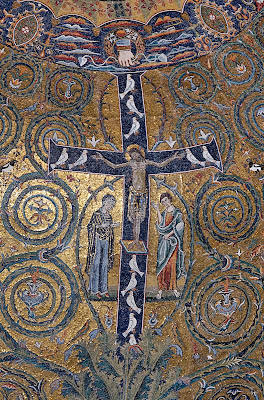
The cross in the apse of San Clemente in Laterano.

Above we see a closer look at the cross of Saint Clement's. In the centre is the crucified Lord. His head hangs limp. "It is finished". The sacrifice has been made. The Pasch's life has been offered to the Most High. And yet we can see that this is not a mournful scene. From the cross springs life. Vines and branches and leaves all shoot forth from the cross. From Adam's sin and the Tree of Life came death; from Jesus' sacrifice and the Tree of Death comes life.
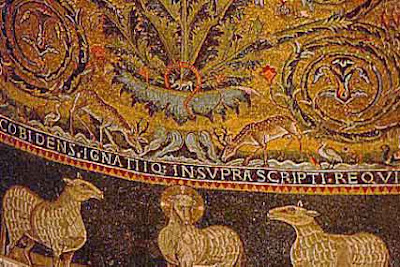

The foot of the cross.

At the foot of the cross, water flows, just as it flowed forth from the side of the Crucified Christ. "As the deer pants for streams of water, so my soul pants for you, O God." The water of baptism comes from the Cross as it is His death that enables us to enter into a New and Perfect Covenant with God. This is the value of the Cross. God uses the Cross to bring redemption, to bring new life, to bring us to himself, to bring reconciliation.

Today is the Feast of the Exaltation of the Holy Cross. Thanks be to God for the Holy and Life-Giving Cross.
Friday, 20 June 2008

Saint Alban


Albanum egregium fæcunda Britannia profert
("Fruitful Britain holy Alban yields").

From Wikipedia:

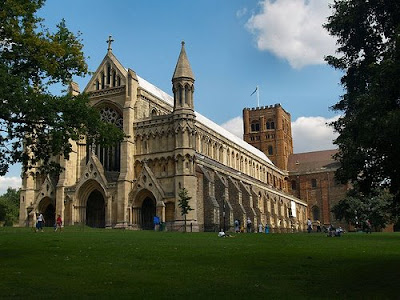
Alban sheltered a Christian priest (Geoffrey of Monmouth's later interpolation giving his name as "Amphibalus", the name for the cloak) in his home, and was converted and baptised by him. When the "impious prince", as Bede has called him, sent Roman soldiers to Alban's house to look for the priest, Alban exchanged cloaks with the priest and was arrested in his stead at Chantry Island. Alban was taken before the magistrate, who was furious at the deception and ordered that Alban be given the punishment due to the priest if he had indeed become a Christian. Alban declared, "I worship and adore the true and living God who created all things." These words are still used in prayer at St Albans Abbey. St Alban was eventually sacrificed to the Roman gods and was condemned to death. He was taken out of the town across the River Ver to the top of the hill opposite. The reputed place of his beheading is where St Albans Cathedral now stands.


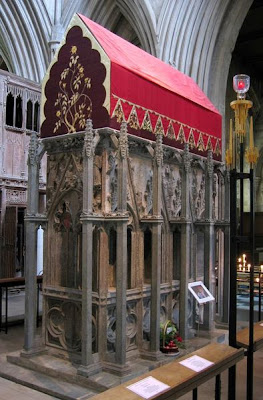
In June 2002 a clavicle (collar bone), believed to be a relic of St Alban, was presented to St Albans Cathedral and placed inside the saint’s restored 13th century shrine. The bone was given by the Church of St Pantaleon in Cologne, Germany. St Pantaleon's, like St Albans Cathedral a former Benedictine abbey church that had a shrine dedicated to St Alban, has possessed remains believed to be those of St Alban since the 10th century. It is entirely possible that further relics were acquired by the church in the 16th century at the time of the Dissolution of the Monasteries in England, when many such relics were smuggled abroad to prevent their destruction. St Albans Abbey was dissolved in 1539.


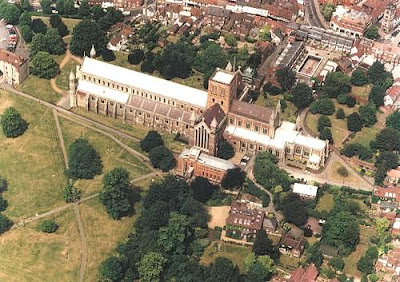
I have a relative who lives in a small village outside modern St Alban's, and during a visit earlier this year I was privileged to visit the Cathedral. I will readily admit that I am not easily impressed by Cathedrals; the close proximity of Durham Cathedral, one of the most beautiful structures ever built by man, sort of spoils the rest. However, I can honestly say that St Alban's Cathedral took my breath away. The first thing you notice is the sheer length of the nave and chancel.


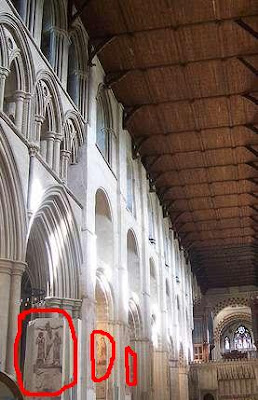
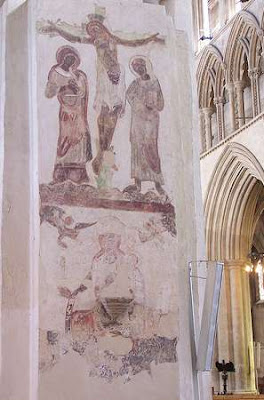
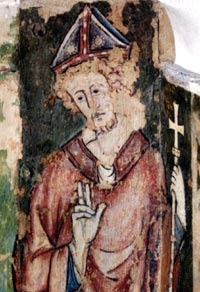
The next thing one notices, upon entering the cavernous interior of the cathedral, is the stunning array of primitive wall paintings. The medieval paintings found on the pillars of the nave (highlighted) are truly remarkable, and each was originally above a small stone altar at which Benedictine monks could say Mass individually.


I believe that this last picture, above, is situated next to the Shrine itself and may depict St Willaim of York. It reminds me of the painting of St Cuthbert in the Gallilee Chapel of Durham Cathedral, above the tomb of St Bede, which is shown on the sidebar of this very blog :-)

When thinking about the circumstances of St Alban's noble martyrdom, his selflessness, and his testimony to the fact that there is indeed "no greater love" than to "lay down one's life for one's friends", I find it hard not to draw parallels with the martyrdom of St Maximillian Kolbe. Both victims of a tyranny. Both exchanged their own lives to save another. Both brought such glory to God by doing so.

Millenia apart, God called each to a painful vocation of martyrdom, and each responded with such unlimited and self-giving love as to seek to imitate Christ's own.

St Alban!

Ora pro nobis!

Friday, 2 May 2008

News from US

Taken from Una Voce Carmel.

Fishers, Indiana, - In a move unprecedented by any American bishop, His Excellency William A. Higi, Bishop of the Diocese of Lafayette in Indiana has proposed an entire parish campus design with traditional architecture. This includes not only a beautiful gothic style church, but a parish life center, youth building, grade school, high school, rectory and convent.

Wednesday, 27 February 2008

I'm back!

Well, its nice to be back in the UK, having had a fantastic week away in France. I arrived at the weekend, but pure laziness has prevented me from blogging until now. :-)

While skiing on the Continent, I stumbled across the resort's "church". Nominally Catholic, it was a squat, ugly, grey building. Not content with being built out of the most sinfully dull and cheap materials, it also refused to conform to basic geometry, the east wall not being perpendicular to the north and south, resulting in an even uglier church of trapezium shape. Worse still, the altar was off-centre, built out of roughly hewn stone resembling breeze blocks, oval (looked like some kind of kiln), with a polished wooden top, no crucifix, and worst of all - the tabernacle was placed in the centre of this monstrous altar in the form of a brass dunces cap, being a strange cone sunk into the surface of the altar - and not even a light to suggest to my confused self what it actually was! It took several minutes to work out what it must be! Needless to say this was in France..
:-P

These people should be reported to the New Liturgical Movement!