Monday, 22 December 2008

It pleased the LORD to bruise him... his soul an offering for sin


"Yet it pleased the LORD to bruise him; he hath put him to grief: when thou shalt make his soul an offering for sin" (Isaiah 53:10)


Christmas is a warm and cuddly story. There is a healthy baby boy, a loving mother, a caring father. There is starlight and angel voices, amazed shepherds and visitors from the orient; there are barnyard animals and a loyal donkey.


We are constantly reminded, however, of the hardship involved. Mary was heavily pregnant, there was no room in the inn, Herod was hunting down the rival for his throne. We would do well to remember that all these hardships are superficial and are not essential to our salvation. It is what comes later that makes the difference.


The Nativity is the feast of Our Lord's Incarnation. The Divine Word took human flesh not on a whim but for a very specific purpose. The Christ-child was on a mission, not a holiday. The babe lying in the manger was spotless and pure, the immaculate son of a holy mother, through whom we are "made holy through the sacrifice of (his body) once for all" (Cf. Hebrews 10:10).


This is, of course, promised to man long before the Incarnation. The Prophet Isaiah announces that a "Suffering Servant" will come. Christ is a servant because, born under the Law, He lived a human life in obedience to the Father. He suffers because He is the Paschal lamb.


When the Hebrews fled Egypt, as God passed over Egypt at midnight, they had the blood of a sacrificial lamb daubed over their doorposts. "For the LORD will pass through to strike the Egyptians; and when He sees the blood on the lintel and on the two doorposts, the LORD will pass over the door and not allow the destroyer to come into your houses to strike you." (Exodus 12:23). Just as the Jews were saved by the blood of the lambs of that first passover, so we are saved by the blood of Christ the Paschal Lamb.


Isaiah puts it thus "Yet it pleased the LORD to bruise him; he hath put him to grief: when thou shalt make his soul an offering for sin" (Isaiah 53:10). Even though the Christ-child is God's own beloved Son, more pure and holy and precious than anything in the whole universe, God's plan is still that of sacrifice. The babe in the manger will grow up to be bruised, put to grief, and ultimately his soul shall be made an offering for sin.


It's easy to forget this at Christmas time. The liturgical year has Christmas and Easter rather neatly divided. There is but a shadow of a connection between the two insofar as the Annunciation usually falls in Lent. Yet the two are intrinsically and unavoidably linked. From the moment of His birth, Christ's life steadily and sombrely progressed towards Calvary, where the blood of the Son of God would be shed.


If we are to remind the world that Christmas has a meaning, let's remember that it isn't just the Incarnation of our God, but the provision of our Paschal Lamb. In the words of the Patriarch Abraham: "God will provide for Himself the lamb" (Genesis 22:8).

Friday, 5 December 2008

Death of Alexei II of Moscow


MOSCOW (AFP) — Russian Orthodox Church patriach Alexy II -- a conservative who oversaw a post-Soviet renaissance of the Russian Church, yet was steadily criticised as subservient to the Kremlin -- died on Friday. He was aged 79.

Alexy, 79, died at his secluded residence outside Moscow. No cause of death was announced officially, but state news agency RIA Novosti, quoting church sources it did not name, said he had died of a heart attack.

An emergency church synod was to convene in Moscow on Saturday to make arrangements for a funeral, which is expected next week but whose date has yet to be announced, and begin deliberations on a successor.

Under church tradition, the synod has up to six months to select a new patriarch.

Russian politicians including President Dmitry Medvedev and Prime Minister Vladimir Putin quickly offered their condolences.

"A great sorrow has befallen our country, our society," Medvedev said in a statement, calling Alexy II "a great citizen of Russia."

A spokeswoman said Medvedev was postponing a planned visit to Italy this weekend and would return directly to Moscow.

Putin called the death "a great loss" and added that "he did very much for the establishment of a new Russian statehood."

In Vatican City, Pope Benedict XVI said he was "profoundly saddened" and expressed grief on behalf of the Roman Catholic Church, whose relations with Russian Orthodoxy have long been wary.

"I am pleased to recall the efforts of the late Patriarch for the rebirth of the Church," he said in a message to the Holy Synod of the Russian Orthodox Church, citing the "severe ideological oppression" of the Soviet era.

Despite leading the church during a period of robust revival, Alexy II was regarded by many as essentially an establishment figure and was criticised by some as being too ready to serve the Kremlin's political causes.

Born Alexei Ridiger, he made his ecclesiastical career at a time when the church was controlled by Soviet authorities before forging an alliance with the new Russian state under presidents Boris Yeltsin and Vladimir Putin.

The patriarch was an impressive character with a benign expression and moral authority among millions of Russian believers but his personality was always locked in by the deeply hierarchical nature of his role.

Alexy II took stances on foreign policy issues that often matched the Kremlin line, criticising NATO strikes against Yugoslavia, the US-led war in Iraq and defending the rights of ethnic-Russians in the former Soviet Union.

But his role in the international arena was marked above all by wariness of Roman Catholics, whom he accused of "proselytism," and he refused repeatedly to meet Pope John Paul II and his successor Benedict XVI.

He was also, however, a unifying Orthodox figure who helped engineer a union with a branch of the Russian Orthodox church that separated from Moscow-based church authorities after the 1917 Soviet revolution.

Ridiger was born on February 23, 1929 in then independent Estonia, the son of an Orthodox priest. He worked in two cathedrals after Estonia became part of the Soviet Union and entered a religious seminary under Stalin.

He married but then divorced in order to become a monk in 1961 during the anti-religion campaigns launched by Soviet leader Nikita Khrushchev. He was soon promoted to bishop.

Ridiger had a successful career under Leonid Brezhnev at a time when the Orthodox church was effectively controlled by the KGB and dissident priests were thrown into jail.

Despite his ties with the Communist establishment, he made some efforts to curb Soviet repression, including keeping open a famous convent in Estonia that was threatened with closure.

He became patriarch in 1990, shortly before the fall of the Soviet Union.

At the time, Alexy was seen as more in touch with the reforms to the Soviet system being undertaken by Mikhail Gorbachev than another candidate, metropolitan Filaret, considered even closer to the Communist regime.

The new patriarch remained prudent after the fall of the Communist system, ruling out investigations against church officials accused of links to the Soviet secret services.

In close collaboration with Yeltsin and Putin, Alexy II used his close relations with the authorities to rebuild the influence of the Orthodox church.

Seminaries were restored, churches rebuilt and church finances greatly boosted by income from customs duties granted by the Russian government during the 1990s.

The lavish Christ the Saviour cathedral in central Moscow, which was destroyed under Stalin and replaced by an open-air swimming pool, was rebuilt in full splendour during Alexy II's patriarchate.

Saturday, 22 November 2008

The sign of peace and the nature of the liturgy

Fr Z reports on the possibility of the sign of peace in the OF of the Roman Rite being transferred to before the Offertory. He comments thus:

Hmmm…With due respect, while I understand the biblical foundation for shifting the sign of peace before you bring your gifts to the altar (cf. Matthew 5:23-24), the sign of peace has been where it is in the Roman Rite for a very long time. It must also be noted that the invitation for the sign of peace in the Novus Ordo is optional. It doesn’t have to be done most of the time. It is not of absolute value. This move seems to make it something it has never been.Also, is this not merely an artificial imposition of a change on the structure of Mass?Actually… that was a rhetorical question.This is an artificial change, not an organic. Sure, the sign of peace is in a different place in the Ambrosian Missal. So what? This is the Roman Rite we are talking about. The upshot of this is that the older, traditional form of the Roman Rite, the TLM, now would seem to be even more, if this goes through, the exemplar of stability.

My thoughts? The liturgy is made for man, not man for the liturgy. If such a change will help emphasise the reverence due to the Real Presence, and if there is no doctrinal necessity for the peace being in it's current position, then I'm all far the change. :-)


Wednesday, 24 September 2008

Wise words.

O generous love! that He, who smote,
In Man for man the foe,
The double agony in Man
For man should undergo.

And in the garden secretly,
And on the Cross on high,
Should teach His brethren, and inspire
To suffer and to die.

Now, name that hymn!

Saturday, 20 September 2008

Never a truer word spoken...

A man who was merely a man and said the sort of things Jesus said would not be a great moral teacher. He would either be a lunatic - on the level with a man who says he is a poached egg - or he would be the devil of hell. You must take your choice. Either this was, and is, the Son of God, or else a madman or something worse. You can shut Him up for a fool or you can fall at His feet and call Him Lord and God. But let us not come with any patronising nonsense about His being a great human teacher. He has not left that open to us. He did not intend to.

C.S. Lewis

Thursday, 18 September 2008

Le Pape en France!


Prayer Request

Could readers please pray for a friend of mine who is joining the Royal Marines in the new year. Pray that he is making the right choice, that he will be safe and well, and that he will keep his (Anglican) faith.

Thanks, folks :)

Sunday, 14 September 2008

The Life-Giving Cross

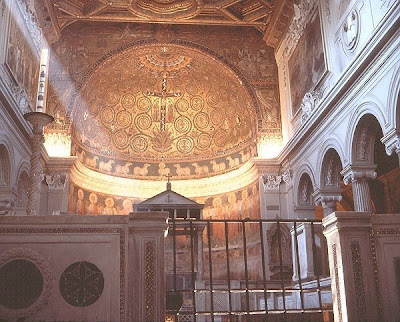
No visit to Rome, the Eternal City, would be complete without a visit to the Basilica of Saint Clement. A short walk away from both Saint John Lateran and the Colosseum, this ancient church is an architectural Victoria Sponge Cake, consisting of three levels; A medieval basilica on top, a far earlier church in the middle, and the dark dank remains of an ancient Roman street (complete with Mithraeum) beneath the two. The Mithraeum on the lowest level, and the wall-paintings on the middle layer are impressive in their own right, but upon entering the Church there is one treasure instantly beholden to the eye.


In the apse of this magnificent church is on of the most resplendent and opulent mosaics of the Christian world. It is quintessentially Roman, with a triumphal arch dividing the Apse from the main body of the Church, flanked by the imposing figures of "Agios Petrvs" and "Agios Pavlvs", the two apostles presiding over the altar below and gesturing towards the apse. On the triumphal arch there is a small picture of Christ blessing the faithful, but this is clearly not the focus of the church.


Unlike in later Western Churches the focus is not on a statue, of a magnificent altarpiece, or on a great window, or on a crucifix. Unlike in the East there is no Pantokrator solemnly presiding over the congregation. Instead, the apse mosaic is centred on one beautiful subject, the Holy and Life-Giving Cross.


We are all familiar with the Cross being called "Holy". In Anglican circles, September 14th is known by the unassuming title of "Holy Cross Day", and is these days linked to an Anglo-Catholic confraternity of like-minded priests. Yet how can we call the Cross "life-giving".


The cross was an instrument of torture. It is the weapon by which our Lord was put to death. It is the symbol of Deicide, the greatest sin of man, and of Regicide, when the Jews rejected their own anointed King. It is a symbol of oppression by a foreign power, upon which a native was murdered at the pleasure of a foreign potentate, by which the soil of the Promised Land was to soak up the Precious Blood of the Redeemer of the World.


And yet the cross is life-giving.

The cross in the apse of San Clemente in Laterano.

Above we see a closer look at the cross of Saint Clement's. In the centre is the crucified Lord. His head hangs limp. "It is finished". The sacrifice has been made. The Pasch's life has been offered to the Most High. And yet we can see that this is not a mournful scene. From the cross springs life. Vines and branches and leaves all shoot forth from the cross. From Adam's sin and the Tree of Life came death; from Jesus' sacrifice and the Tree of Death comes life.


The foot of the cross.

At the foot of the cross, water flows, just as it flowed forth from the side of the Crucified Christ. "As the deer pants for streams of water, so my soul pants for you, O God." The water of baptism comes from the Cross as it is His death that enables us to enter into a New and Perfect Covenant with God. This is the value of the Cross. God uses the Cross to bring redemption, to bring new life, to bring us to himself, to bring reconciliation.

Today is the Feast of the Exaltation of the Holy Cross. Thanks be to God for the Holy and Life-Giving Cross.

Wednesday, 10 September 2008

Ecclesiastical Fashion


...And now, modelling the 2008 Pontifical Cagliari range, His Holiness Pope Benedict...

Cathedral Mass - Missal of Blessed John XXIII

rom the cathedral website:

Extraordinary Form of the Mass

There will be a celebration of Mass according to the Extraordinary Form of the Roman Rite (Missale Romanum 1962) in the Cathedral on Saturday 13th September at 6.00pm.

This Mass, celebrated in honour of Our Lady, is in thanksgiving on the occasion of the Fortieth Anniversary of the promulgation of Pope Paul VI’s Encyclical 'Humanae Vitae.'

All are welcome.

St. Mary's Cathedral
Clayton Street West
Newcastle upon Tyne NE1 5HH