Saturday, 22 November 2008

The sign of peace and the nature of the liturgy

Fr Z reports on the possibility of the sign of peace in the OF of the Roman Rite being transferred to before the Offertory. He comments thus:

Hmmm…With due respect, while I understand the biblical foundation for shifting the sign of peace before you bring your gifts to the altar (cf. Matthew 5:23-24), the sign of peace has been where it is in the Roman Rite for a very long time. It must also be noted that the invitation for the sign of peace in the Novus Ordo is optional. It doesn’t have to be done most of the time. It is not of absolute value. This move seems to make it something it has never been.Also, is this not merely an artificial imposition of a change on the structure of Mass?Actually… that was a rhetorical question.This is an artificial change, not an organic. Sure, the sign of peace is in a different place in the Ambrosian Missal. So what? This is the Roman Rite we are talking about. The upshot of this is that the older, traditional form of the Roman Rite, the TLM, now would seem to be even more, if this goes through, the exemplar of stability.

My thoughts? The liturgy is made for man, not man for the liturgy. If such a change will help emphasise the reverence due to the Real Presence, and if there is no doctrinal necessity for the peace being in it's current position, then I'm all far the change. :-)


Wednesday, 24 September 2008

Wise words.

O generous love! that He, who smote,
In Man for man the foe,
The double agony in Man
For man should undergo.

And in the garden secretly,
And on the Cross on high,
Should teach His brethren, and inspire
To suffer and to die.

Now, name that hymn!

Saturday, 20 September 2008

Never a truer word spoken...

A man who was merely a man and said the sort of things Jesus said would not be a great moral teacher. He would either be a lunatic - on the level with a man who says he is a poached egg - or he would be the devil of hell. You must take your choice. Either this was, and is, the Son of God, or else a madman or something worse. You can shut Him up for a fool or you can fall at His feet and call Him Lord and God. But let us not come with any patronising nonsense about His being a great human teacher. He has not left that open to us. He did not intend to.

C.S. Lewis

Thursday, 18 September 2008

Le Pape en France!


Prayer Request

Could readers please pray for a friend of mine who is joining the Royal Marines in the new year. Pray that he is making the right choice, that he will be safe and well, and that he will keep his (Anglican) faith.

Thanks, folks :)

Sunday, 14 September 2008

The Life-Giving Cross

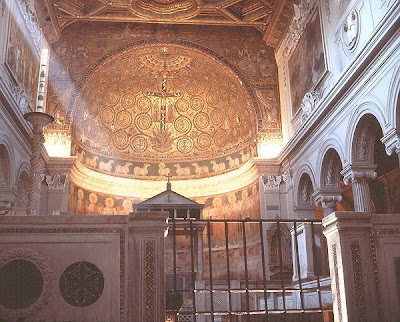
No visit to Rome, the Eternal City, would be complete without a visit to the Basilica of Saint Clement. A short walk away from both Saint John Lateran and the Colosseum, this ancient church is an architectural Victoria Sponge Cake, consisting of three levels; A medieval basilica on top, a far earlier church in the middle, and the dark dank remains of an ancient Roman street (complete with Mithraeum) beneath the two. The Mithraeum on the lowest level, and the wall-paintings on the middle layer are impressive in their own right, but upon entering the Church there is one treasure instantly beholden to the eye.


In the apse of this magnificent church is on of the most resplendent and opulent mosaics of the Christian world. It is quintessentially Roman, with a triumphal arch dividing the Apse from the main body of the Church, flanked by the imposing figures of "Agios Petrvs" and "Agios Pavlvs", the two apostles presiding over the altar below and gesturing towards the apse. On the triumphal arch there is a small picture of Christ blessing the faithful, but this is clearly not the focus of the church.


Unlike in later Western Churches the focus is not on a statue, of a magnificent altarpiece, or on a great window, or on a crucifix. Unlike in the East there is no Pantokrator solemnly presiding over the congregation. Instead, the apse mosaic is centred on one beautiful subject, the Holy and Life-Giving Cross.


We are all familiar with the Cross being called "Holy". In Anglican circles, September 14th is known by the unassuming title of "Holy Cross Day", and is these days linked to an Anglo-Catholic confraternity of like-minded priests. Yet how can we call the Cross "life-giving".


The cross was an instrument of torture. It is the weapon by which our Lord was put to death. It is the symbol of Deicide, the greatest sin of man, and of Regicide, when the Jews rejected their own anointed King. It is a symbol of oppression by a foreign power, upon which a native was murdered at the pleasure of a foreign potentate, by which the soil of the Promised Land was to soak up the Precious Blood of the Redeemer of the World.


And yet the cross is life-giving.
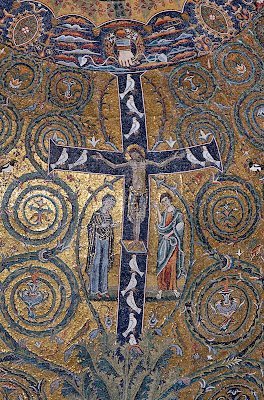
The cross in the apse of San Clemente in Laterano.

Above we see a closer look at the cross of Saint Clement's. In the centre is the crucified Lord. His head hangs limp. "It is finished". The sacrifice has been made. The Pasch's life has been offered to the Most High. And yet we can see that this is not a mournful scene. From the cross springs life. Vines and branches and leaves all shoot forth from the cross. From Adam's sin and the Tree of Life came death; from Jesus' sacrifice and the Tree of Death comes life.
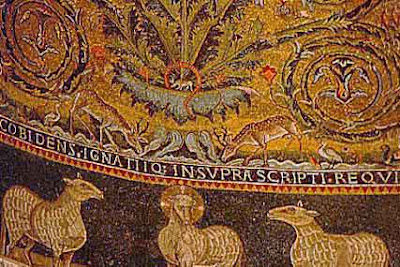

The foot of the cross.

At the foot of the cross, water flows, just as it flowed forth from the side of the Crucified Christ. "As the deer pants for streams of water, so my soul pants for you, O God." The water of baptism comes from the Cross as it is His death that enables us to enter into a New and Perfect Covenant with God. This is the value of the Cross. God uses the Cross to bring redemption, to bring new life, to bring us to himself, to bring reconciliation.

Today is the Feast of the Exaltation of the Holy Cross. Thanks be to God for the Holy and Life-Giving Cross.

Wednesday, 10 September 2008

Ecclesiastical Fashion


...And now, modelling the 2008 Pontifical Cagliari range, His Holiness Pope Benedict...

Cathedral Mass - Missal of Blessed John XXIII

rom the cathedral website:

Extraordinary Form of the Mass

There will be a celebration of Mass according to the Extraordinary Form of the Roman Rite (Missale Romanum 1962) in the Cathedral on Saturday 13th September at 6.00pm.

This Mass, celebrated in honour of Our Lady, is in thanksgiving on the occasion of the Fortieth Anniversary of the promulgation of Pope Paul VI’s Encyclical 'Humanae Vitae.'

All are welcome.

St. Mary's Cathedral
Clayton Street West
Newcastle upon Tyne NE1 5HH

Friday, 29 August 2008

Apologies... not faith, the sorry kind.

My humblest apologies that I haven't posted recently. I have been rather busy over this summer. Please bear with me, I hope to resume any day now :-)

Saturday, 9 August 2008

From Holy Smoke

Worrying news:
(Stolen from Holy Smoke)


The New Mass being celebrated at St John the Evangelist

One hundred parishioners of St John the Evangelist, Allerton Bywater, have petitioned their bishop, the Rt Rev Arthur Roche, to allow the parish to celebrate Mass only in Latin, in both the old and new forms. Instead, he is closing the church this month and has told the parish priest, Fr Mark Lawler, that he will not be appointed to a new parish because his ministry is "divisive".

Fr Lawler told me today: "This is a parish that does exactly what the Holy Father tells us to do, celebrating the Mass reverently in the old and new forms. The bishop is determined to squash it, and to destroy me because he doesn't want me moving to another parish and doing the same thing."

The parish pastoral council has written to Bishop Roche asking why he has ignored its two formal petitions for the status of a "personal parish" celebrating Mass only in Latin, in accordance with Article 10 of Summorum Pontificum, Pope Benedict's apostolic letter liberating the traditional Latin Mass.

It has now retained the services of a leading canon lawyer to challenge Bishop Roche's decision to close the parish as part of a wider programme of closures.

Relations between Bishop Roche and Fr Lawler have been strained for years. The bishop told Fr Lawler some time ago that he wanted him to say Mass facing the people, and that because he had told him what to do it was therefore the will of the Holy Spirit.

Pope Benedict, in contrast, has written at length defending the ancient practice of celebrating the Eucharist facing east. He has also given priests the legal right to celebrate a public Mass in the traditional rite if they are approached by a stable group of the faithful, however small. At St John's, the vast majority of regular worshippers have asked for the old rite to be made available. On August 17, their church will be closed by the diocese.

Fr Lawler says he asked for a meeting with Bishop Roche, but to no avail. Instead, the Vicar General, one Mgr McQuinn, has written to him, telling him: "The Bishop ... believes your ministry to be divisive, is uncertain that ordinary pastoral care of parishioners is taking place and does not have confidence that you will celebrate the Ordinary Form of the Mass with a generous heart for the vast majority of parishioners who expect Sunday and weekday Masses to be in English and at an altar facing the people."

In an open letter to his parishioners, Fr Lawler describes this claim as "a slur on my character, an attack upon my priesthood and totally without foundation."

Clearly, this matter must now go to Rome. Perhaps the pontifical commission Ecclesia Dei might be persuaded to take a closer look at the scandal unfolding in Allerton Bywater.